Jubrakanews – Report
By Eisa Dafallah
Mujahid Al-Tahir Saeed, 36, graduated from the Faculty of Economics at the University of Khartoum and holds a master's degree from Sudan University. He is a businessman specialising in the import of medical equipment and medicines. He operates under the name “Jorjarat,” importing medical equipment through Nirva International Company for .multiple Activities Ltd. The company's headquarters are in Khartoum, while his business premises in El Fasher were located on Livestock Market Street
The Fall of El Fasher
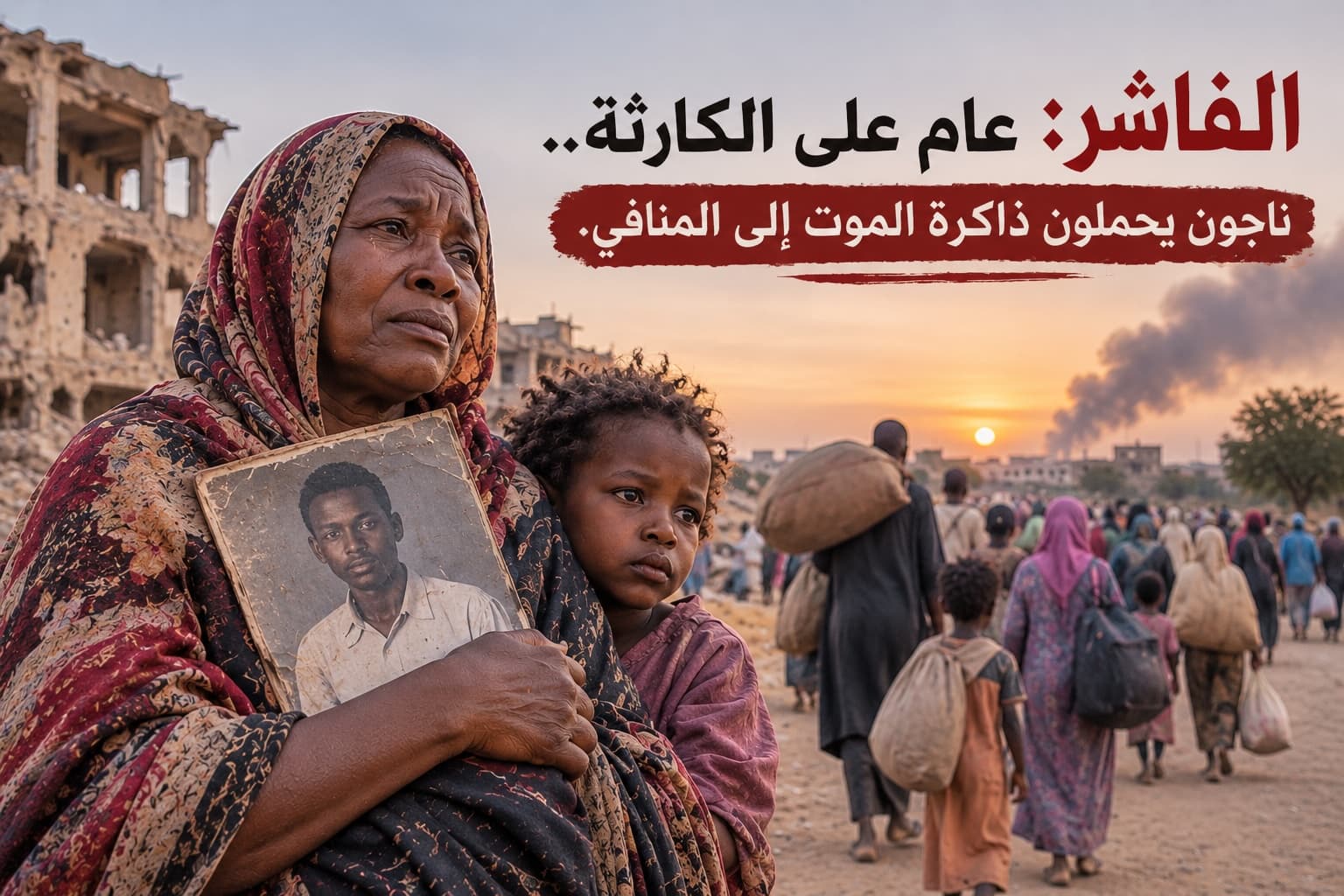
El Fasher, the capital of North Darfur State, fell to the Rapid Support Forces (RSF) on October 26, 2025, following a 28-month siege during which civilians were subjected to starvation and bombardment by drones and artillery. The siege resulted in thousands of deaths and the displacement of more than 1.5 million people. Mujahid remained in El Fasher throughout most of the siege until October 18, 2025, when he left the city, eight days before its fall on October 26.
Working During the Siege
Throughout the siege, Mujahid continued operating from his company's premises, supplying medical equipment and medicines to pharmacies and hospitals, particularly the Southern Hospital and the Saudi Hospital, both of which continued functioning until the city fell. He also supplied medicines and medical equipment to military entities, including the army, police, and the Joint Force of the armed movements, as well as to civilians through pharmacist employees. Mujahid was responsible for management and imports.
Mujahid says that after the siege was imposed on the city, he established Al-Yasmin Medical Clinic, a division of his company, to provide treatment for the wounded and injured. He adds that the clinic's main premises, located on Livestock Market Street south of the Police Mosque, were bombed, forcing him to relocate it to Airport Street, near Nour Al-Iman Hotel, where it continued operating until October 18.
The medical centre on Livestock Market Street, south of the hospital, provided treatment to wounded people from all sides without discrimination based on their affiliation, with particular attention given to civilians.
The Family's Suffering
Mujahid says that most of his family members left El Fasher because of the bombardment, while some remained and endured severe hardship. He notes that several family members are still missing, and their whereabouts remain unknown. He adds: “After families left and became scattered, we young men began living together during the siege.”
He says: “There was not a single residential neighbourhood in El Fasher without people wounded or killed by the bombardment. In most cases, homes were destroyed, and El Fasher became a ghost town.”
The Military Situation in the City
According to Mujahid, the army was deployed in the city centre and western districts, while the RSF had been stationed in the eastern part of the city since the beginning of the war.
He says the eastern part of the city suffered extensive destruction as a result of airstrikes carried out by army warplanes, which, according to his account, numbered more than three strikes a day, in addition to drone attacks. He adds that these attacks destroyed civilian homes, particularly as RSF forces were stationed inside some houses and established military positions in residential neighbourhoods, forcing residents to flee.
As for the central and western parts of the city, Mujahid says they were shelled by the RSF, which used various types of weapons, including artillery, tanks, and drones. He adds that the bombardment was intense during the morning, daytime, and night. “I was between the city centre and the west, in areas controlled by the army, and we lost people dear to us,” he says.
Mujahid says he decided to remain in El Fasher to serve the community, while his family endured severe hardship before its members were eventually able to leave the city. He adds: “Entire families were wiped out in El Fasher when their homes were bombed. We had three neighbouring families whose members were all killed. Most of those killed had died before the city fell because of the bombardment.”
According to Mujahid, residents abandoned the city because of the intensity of the shelling, which he described as unprecedented in any area of Sudan during the war compared with what El Fasher experienced.
Fighters from South Sudan
Mujahid also spoke about the presence of fighters from South Sudan in the city. He said some were originally from El Fasher and had fought alongside the army, while others, he claimed, had been brought from South Sudan by the RSF. He added that some of these fighters were captured by the army inside El Fasher.
He said he learned this information from army officers, adding that they had spoken about the capture of Colombian mercenaries. He also said he had seen photographs of them near the historic El Fasher Mosque in the Grand Market.
Leaving El Fasher
Mujahid says he left El Fasher on October 18, after sunset prayers, through the western side of the city. He adds that El Fasher was surrounded by a massive trench located approximately three kilometres west of the city.
“I decided to head west because the south was under RSF control, including Zamzam Camp, as were the east and the north,” he says.
His destination was Tawila, located in an area controlled by the Sudan Liberation Movement led by Abdel Wahid Mohamed Nour, approximately 60 kilometres away. He adds: “I left with my friend and headed towards the University of El Fasher, then westwards to the army's last checkpoint. We found soldiers there, but they did not question us because we were trying to leave the city.”
He says the first trench surrounded the city and was approximately two metres wide and two metres deep, by his estimate. “If you fell into it, someone would have to pull you out,” he says. He says around 20 young men set out from the University of El Fasher. After covering approximately two kilometres, they encountered another trench surrounding the city. They managed to cross it after walking for about two hours.
“We encountered a small RSF unit that opened fire on us, so we scattered. Some of us were wounded and fell, but my friend and I stayed together and decided that we would not return to El Fasher,” he says.
Some of those fleeing headed south, while others went west and north. Mujahid and his friend remained together. “We had only about two litres of water with us. Even inside El Fasher, getting water was difficult. Conditions were harsh; the only food available was ambaz [animal feed], and a sack of it was selling for six million Sudanese pounds at the time. There was no chance of living. Even toothpaste was unavailable. We washed our clothes with soap, with a single bar costing as much as five dollars, while people were washing clothes using the leaves of the Lalob tree.”
He says: “We decided that even if we died, we would never eat ambaz again.” He adds that they continued walking throughout the night. By October 19, exhaustion had overwhelmed them and their water had run out. They could find no nearby water source.
“We were forced to eat the moist roots of the haskanit plant to moisten our throats. We ate a very large quantity of them. When the sun became unbearably hot, we lay down under a tandub tree for about 15 minutes,” he says.
Abduction by Kidnappers
According to his account, four men riding camels approached them afterwards.
“They called us ‘Falangayat’, a racist term used to refer to slaves and asked us where we had come from. We told them we were from El Fasher and were heading to Tawila,” he says.
He says his friend, who belongs to the Qadhadhfa tribe, was not questioned. But when he told the men that he was Zaghawa, they replied: “You are the one we want.”
He adds that one of the men insulted him, saying that his father had been killed by someone from the Zaghawa tribe and that he had lived as an orphan for 40 years.
The men then searched their pockets. They found Mujahid's phone, whose screen was broken, and confiscated it along with 30,000 Sudanese pounds. They took 50,000 pounds from his friend.
Mujahid says the four men remained on their camels while he and his friend walked ahead of them for approximately five hours.
“We were exhausted. Thorns pierced our feet, and we kept falling and getting back up until we reached a dry valley. They brought us water and served us asida with stew,” he says.
He says that between the place where they were stopped and the dry valley, they came across people who had been with them when they left the University of El Fasher and who were now dead.
“We recognised them by their clothes. They asked us, ‘Do you know them?’ We said no,” he adds. He says the men told them they had been following them and that the group that had left the university numbered more than 20 people. “We told them that only two of us had left together,” he says.
At the dry valley, Mujahid says the men spread out a mat for them. The four men slept at the corners of the area, while he and his friend were placed in the middle.
“They told me, ‘You Zaghawa are criminals,’ and then tied my hands and feet,” he says.
The following morning, they arrived at an area covered in grass and were told to sit there while the men went away to consult among themselves.
After a while, the men returned and said to him: “You are Zaghawa. This man needs you to pay compensation for his father, who was killed by a Zaghawa man 40 years ago. If you pay him, we will release you.”
As for his friend, they told him: “Go. We do not want you.” But his friend refused to leave, telling them: “We came together, so either you release us together or kill us together. I will not leave my friend behind.”
Mujahid says he realised then that the men wanted a ransom. He negotiated with them and agreed to pay 30 million Sudanese pounds in exchange for their release.
“They said to me, ‘Mujahid, don't you have a brother in Europe or America who can pay for you?’ I told them I did not. If I told them I had someone abroad, they would demand a larger amount. I told them I would borrow money from my friends and that I did not have a bank account,” he says.
They spent the rest of the day in the same place. The men brought them asida and water again, then they continued walking for approximately six hours until they reached another dry valley.
“We dug into the ground in the valley and managed to extract water. Then they chained my hands and feet again, and we spent the night with them,” he says.
The following morning, they drank tea with milk. The men then asked him whether he was a military officer.
“I told them, "No, I am a computer science teacher.'" They asked for his name, and he replied: Mujahid Al-Tahir. He says they searched for his name on social media. Before leaving El Fasher, he had temporarily deactivated his Facebook account for one month.
“They searched Facebook, TikTok and Google, but they found nothing,” he says.
Mujahid says the men subsequently took them to a farm to protect them from the RSF and travellers in armed vehicles.
“They told us: We will take you somewhere where you can transfer money to us, and then we will release you,” he says.
He adds that they spent another day under the same circumstances, without the kidnappers telling them where they were.
The men asked whether they knew the route leading to Tawila. They replied that they did not know the area.
“We walked again for about eight hours through the mountains. My shoes eventually fell apart, so one of them gave me his shoes,” he says.
Mujahid says he realised that the kidnappers were keen to keep him alive because they wanted to obtain money, but he feared that paying the ransom might result in him being handed over to the RSF.
He adds that this situation continued for approximately four days before they eventually reached a small settlement they later learned was called Um Jalbagh.
The kidnappers brought a small saloon car. Mujahid and his friend sat in the back, accompanied by two armed men, while two others sat in the front.
“RSF forces stopped us near a tree with Wi-Fi. They switched on the network and told me: ‘Talk,’” he says.
He called his brother and told him: “I know your circumstances are difficult, but I need some money. Could you get it from the people around you?”
He adds that his brother understood what he meant because they had previously agreed on this method of communication.
“I paid them 30 million pounds. I still have the bank account number that received the money through ten transfers, each worth three million pounds,” he says.
After the kidnappers contacted the account holder and confirmed that the money had arrived, they continued travelling for approximately five hours.
“After that, they told us: ‘That is the main entrance to the Tawila area,’” he adds.
They continued walking for about half an hour until they reached Tawila's northwestern checkpoint.
“When I arrived at the checkpoint, all my clothes were torn. One of the RSF members had taken my shoes, so I arrived barefoot, wearing nothing but a pair of shorts,” he says.
The forces stationed at the checkpoint asked where they had come from. They replied that they only knew they had travelled from a mountainous area.
One of the personnel told them that the area was Um Jalbagh, explaining that many people arriving in Tawila came through that route and that the area was inhabited by social groups aligned with the RSF.
From Tawila to Chad
Mujahid stayed in Tawila for two days before looking for his friend, whom he eventually found in the market.
“He welcomed me, and we bought a needle together to remove the thorns from our bodies. To this day, there are still marks from the thorns on my leg,” he says.
He says his friend told him that forces affiliated with the Sudan Liberation Movement led by Al-Tahir Hajar, which is allied with the RSF, were coming to the area to recruit fighters. He added that the spokesperson for these forces was named Fathi Mohamed.
His friend warned him that remaining in the area could put him at risk because those forces knew of his opposition to them.
Afterwards, his friend travelled to Khazan Jadid and then to Omdurman, while Mujahid went to the town of Martal, then to Fanga in the eastern peaks of the Jebel Marra mountains, followed by Rokero and then Golo.
Mujahid stayed in Golo for a week, where he met a friend who told him that RSF forces were coming to the area from Kabkabiya and advised him to leave Golo.
He says intelligence personnel affiliated with the local administration in the area, which is under the control of the Sudan Liberation Movement led by Abdel Wahid Nour, interrogated him several times.
He subsequently travelled by motorcycle to Jildo, then to Shofigo, followed by Nertiti in Central Darfur State, and finally to Zalingei, the state capital.
He says he was stopped at the western exit checkpoint of Zalingei and sent back into the city after negotiations.
“If they had taken me to the RSF intelligence office, they would have recognised me. During the siege, I used to publish my views from El Fasher about the war and the RSF's attacks on civilians. I was among those being targeted,” he says.
He adds that he paid eight million pounds through Bank of Khartoum's Bankak application, after which he was allowed to return to the checkpoint.
He then boarded a saloon car to Mornay, paying 40,000 pounds for the journey.
Upon arrival, he exchanged 200,000 pounds in cash at a money exchange office and received 150,000 pounds, of which he paid 40,000 for transport.
“The fare from Zalingei to El Geneina was the same, but I did not want them to know my route,” he says.
From Mornay, he boarded another saloon car to El Geneina, arriving after sunset and getting off in the middle of the market.
“I did not know anyone there, so I ate something,” he says. After sunset, he left El Geneina and boarded a vehicle heading to Adikong, paying 30,000 pounds.
However, he was stopped again at the Adikong checkpoint. “They did not recognise me, but they arrested me because I was considered an unfamiliar person. I told them I was a trader going to bring goods, and that I had come from Nyala. Eventually, they said: ‘You are a suspect. Take him to the detention centre,’” he says.
He adds that he paid them three million pounds, after which they released him.
“I went to Adikong and slept on the sand near the Chadian town of Adré. I did not know anyone there,” he says.
He adds that when he found a phone, he accessed his brother's page through his fake account and contacted him. He then deleted the application and the search history.
The following morning, Mujahid says he slept approximately 50 metres from an RSF checkpoint before crossing the border. He paid a sum of money to a member of the Chadian border guards and entered Chadian territory. He then continued his journey.
The Family's Dispersal
Mujahid says his family members became scattered after leaving El Fasher, with relatives ending up in three countries: Egypt, Libya and Chad.
The Testimony of Al-Rashid Al-Tahir
Al-Rashid Al-Tahir, an activist who worked with community kitchens during the war in El Fasher and managed to escape before the massacre, said that this historic sultanate city, with its longstanding leading role in resistance and revolution, had continued, alongside its people, to resist what he described as ugliness and a malignant cancer since the beginning of the war.
He added:
“Yes, this city made its position clear: it would not kneel except over the bodies of its brave sons. They stood as an impenetrable barrier against the Janjaweed, the RSF militia and its foreign mercenaries. They endured and resisted for three years, as the militia unleashed a barrage of heavy artillery and various types of drones against the city, carrying out more than 500 attacks. Nevertheless, women stood alongside men and young people, defending themselves and their existence and protecting their city from these dagger-wielding assailants.”
He added: “They emerged victorious from every battle launched against them, inflicting heavy losses in lives and equipment on the Janjaweed. They seized weapons and many vehicles belonging to what he called the Gulf State of Evil, while many senior RSF commanders were killed in El Fasher.”
He continued: “When they realised that this city was beyond their reach, they resorted to the worst forms of warfare, employing methods that had not even been seen in some world wars, historical conflicts or the Crusades. They first bombed water sources, then markets and hospitals. In the second phase, they imposed a siege on the city that was worse than death. They killed people, sparing neither children, the elderly, women, nor the wounded and sick. They intensified their bombardment of the city, increased drone sorties and targeted mosques, community kitchen gatherings, health centres and even alternative markets inside residential neighbourhoods. People became exhausted and died of hunger after being forced to eat animal fodder and hides.”
The Testimony of Mohamed Bashir
Journalist Mohamed Bashir said that what happened in El Fasher, in North Darfur State, must not be distorted or reduced to terms such as “fall” or “liberation”. Such descriptions may reflect the narratives of the parties to the war, but they neither capture the reality of what happened nor convey the scale of the humanitarian catastrophe experienced by civilians.
He added that the massacre that claimed the lives of thousands of civilians in El Fasher, along with other tragedies witnessed across Sudan's cities, towns, villages and rural areas, should not be turned into political propaganda or used as a tool to promote a particular narrative at the expense of the truth and the suffering endured by civilians.
In this context, he said that all parties to the war had used civilians as human shields during the fighting, stressing that the protection of civilians must remain a priority and must not be subjected to the calculations of the conflict or the interests of the warring parties.
He stressed that massacres should not be judged by who won or lost, but by the scale of the tragedy, the rights of the victims and the extent to which justice is delivered to them.
He added that the blood of Sudanese people must not become a bargaining chip in the battle of competing narratives, that justice is indivisible, and that the truth must not be subjected to the calculations of the parties to the war.