Jubrakanews: Report
“I was threatened by all sides of the war, and even my children were dragged into it. That was a very, very frightening thing that my children could be harmed because of my positions, especially the bullying campaigns and hate speech directed at me.”
This is how Mariam describes one of the most frightening moments she has experienced since the war in Sudan broke out in April 2023. Her political position did not support either side of the war; from the very first day she declared her rejection of the war and called for peace and an end to the fighting.
But this position, she says, was not always read as an independent political stance. Instead, it became an entry point for classifying and targeting her based on her ethnic identity, despite the positions of members of her family who supported the Sudanese Armed Forces. This placed her within the circle of classification and targeting by both sides of the war.
Mariam says the targeting did not stop at accusing her of siding with one of the warring parties but extended to bullying, hate speech, and threats and, in some cases, reached her children.
What is gender-based digital violence?
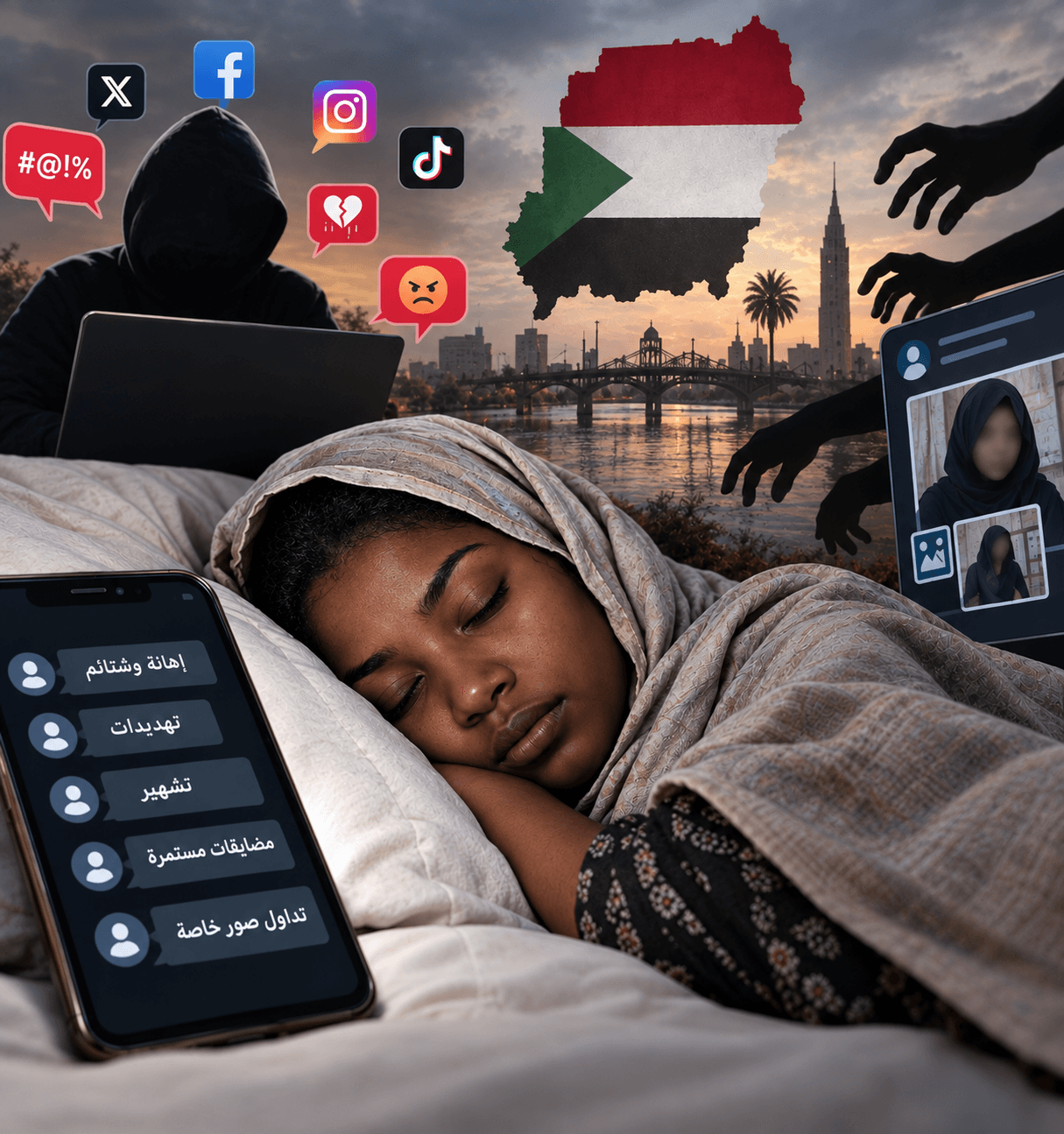
UN Women defines technology-facilitated violence against women as “any act that is committed, assisted, aggravated or amplified by the use of information and communications technology or other digital tools that is likely to result in physical, sexual, psychological, social, political or economic harm, or a violation of rights and freedoms.” The body clarifies that in this definition, “violence against women” may be replaced with the term "gender-based violence” while retaining the same meaning.
This kind of violence is not limited to insults or direct abuse. It includes forms such as online harassment, hate speech, defamation, stalking, the publication of personal information, blackmail, account hacking, and image-based abuse. The UN also emphasises that women who are most visible in public life, including journalists, politicians, human rights defenders, and feminist activists are among those most exposed to this type of targeting.
Nor does the impact of this violence necessarily remain confined to cyberspace; it can move into real life, affecting women’s psychological, social, and professional safety, or escalate into threats and other forms of violence offline.
Mariam Hamed, political activist
Mariam says the targeting of her began when she announced her rejection of the war. She adds, "As someone from Arab tribes in Darfur, I was, and still am, against the war and against both sides. But as soon as I say no to the war, I get classified immediately, and I am subjected to digital violence, or I could call it violence based on my ethnic component, and I am treated as Janjaweed.” She adds that this classification is not linked only to her ethnic affiliation; the political positions of her family members also became a reason for targeting her. Her father is an Islamist, while her mother supports the army, which led the family to be classified as "Kizan", even though each person holds the political position they adopt according to their own convictions.
Mariam says her rejection of the war was not a passing position; she adopted it from the first day of the war and still holds to it. However, these positions, as she describes them, turned into “badges of shame” used by others to intimidate her and accuse her of treason and of being one of “the hotel-and-embassy crowd.” She adds that these classifications shook her at the beginning of the war and frightened her, but today they no longer affect her. She affirms that she will continue to declare her rejection of both warring parties’ violations against civilians and to call for peace and an end to fighting.
She adds that she was not threatened by only one side. She was threatened by different parties in the war, and the targeting reached her children, which she described as one of the most frightening things for her, fearing that her children would be harmed because of her positions. She also says she was subjected to bullying campaigns and hate speech, and that these campaigns affected her greatly. Despite this, Mariam confirms that she no longer allows these classifications and threats to affect her positions and says she will continue to defend and hold fast to her convictions.
She believes that the digital violence experienced by women defenders, feminists, and politicians can be deeply impactful, especially when the targeting turns into mockery of women’s bodies, or hate speech targeting their ethnic components, or attacks against them precisely because they are women. Nevertheless, Mariam says many women have chosen to remain in public life despite the targeting they face "for others like us".
From individual cases to a broader pattern:
Mariam’s experience does not appear to be an isolated case. In a field survey conducted with women political journalists, 20 cases were documented of exposure to different forms of digital violence. The cases ranged from insults, threats, defamation, and hate speech to attempts to fabricate information about the journalists and publish photos or information linked to them; one case reached the level of blackmail and threats to publish personal photos.
To understand the nature of these cases more deeply, in-depth interviews were conducted with five journalists who had been targeted. The testimonies revealed that the threats did not necessarily stop at the boundaries of cyberspace; in some cases, they continued even after the journalists left Sudan, and the targeting extended to members of their families, while the threats pushed others to withdraw from social media.
In one case, the matter was not limited to digital threats: one journalist spent 28 days under house arrest in areas controlled by Abdulaziz al-Hilu in South Kordofan. The cases also reveal that expressing solidarity with women survivors of violence can itself become a reason for targeting. One journalist was targeted after publicly standing in solidarity with women survivors of violence and writing about violations suffered by women in the context of the war.
These cases, in their different forms, indicate that the targeting of journalists was not always directly linked to what they wrote about politics but extended to their positions on the war, their coverage of women’s issues, their solidarity with survivors, and even their private lives and families.
Shamail Al-Nour: "The war 'was the final straw'."
Journalist Shamail Al-Nour sees digital violence in Sudan as inseparable from a political context marked for years by sharp polarisation, beginning in the final years of Omar al-Bashir’s rule and passing through the transitional period, before reaching its peak with the outbreak of war.
She says the war imposed a kind of “flattening of positions", making it difficult for a journalist to preserve an independent space in her coverage. If she covers violations committed by the Rapid Support Forces, she is viewed as pro-army; if she covers violations by the army or publishes information or criticism about its delay in protecting civilians, she is automatically classified as pro-RSF.
Shamail sees this classification as imposing doubled pressure on journalists and affecting their professional performance and the way they cover events. She notes that several journalists stopped working entirely to avoid the psychological pressure that accompanied the war and polarisation. She says the war broke out amid existing political mobilisation and sharp polarisation, but it “was the final straw", in her words, and contributed to increasing the activity of supporters of the former regime, who according to her view became more ferocious because of their anger at the December revolution and their position toward the Rapid Support Forces. She sees this as contributing to “a comprehensive poisoning of social media".
According to Shamail, the Islamists, who are now supporters of the army, represent one of the main parties in this discourse, alongside RSF supporters. She points out that both sides practice pressure and moral intimidation against journalists, albeit to different degrees. She explains that a journalist whose previous positions were associated with one of the camps may remain captive to that classification even after her position changes. Someone who opposes the war today, for example, may have her position reinterpreted based on her earlier positions as pro-army.
Shamail adds that the issue is not limited to declared political positions; even a journalist working from areas under army control who provides professional, independent coverage may be classified as part of its camp, especially if her coverage focuses on RSF violations. She points to accounts operating in a synchronised way to demonise independent female journalists and morally terrorise them, citing what journalists Maha Al-Talb and Lina Yaqoub faced from demonisation and targeting campaigns. Shamail sees the message that independent journalists should hold on to as looking at the other side of this targeting: in some cases, it is evidence that they are practising journalism responsibly in one of the most complex crises.
She says, "There is no choice but to continue down the road with full confidence and full courage.” She adds that the digital violence and moral terror experienced by independent journalists, despite its psychological harm, is a real test of the value of the profession and of the journalist’s steadfastness in holding to the professional position she has chosen.
For Shamail, the value of journalism does not appear in ordinary circumstances or in routine coverage, but in the tests that measure a journalist’s ability to continue doing her job under pressure. She sees the psychological harm and moral terror faced by journalists in these circumstances as something that may later become part of their professional credit, and that resilience in the face of it makes a difference in their careers.
When the political intersects with the ethnic and the feminist
The experience of Hiba (a pseudonym) shows another aspect of targeting, where political positions intersect with ethnic hatred and gender. Hiba says she is exposed to multiple forms of digital violence, including insults, threats, attempts at defamation, the fabrication of her name in defamatory content, and the publication of photos from her Facebook account. She recounts waking up one day to find posts claiming she had led a demonstration in London against civilian forces, which she denies, in addition to receiving messages containing hate speech.
She says the latest incident happened about ten days before the interview, when a person she does not know and whose motives she does not know attacked her using repeated insults and severe intimidation and humiliation, including racism, misogyny, lies, and false information about her. Hiba says the targeting did not stop with her alone but reached her family as well, through repeated references to her father’s political affiliations, which she says she has previously responded to and clarified her position on.
Hiba explains that sometimes she reports offensive content, and it is removed, while at other times she chooses to ignore it and continue her activity. But she says the matter is different when the targeting becomes deliberate and continuous, adding that she is in the process of taking legal action against an activist who recently attacked her over what she describes as favouritism toward some employers.
Despite the repetition of these attacks, Hiba says she has not stopped her activity and has not allowed digital violence to change her position, because she considers it “one of the tools used to fight back” when a person has a clear and firm position. She sees the motives for targeting her as multiple, including her political position, ethnic hatred, misogyny, and sometimes what she describes as “hostility to success", saying these factors often intersect with attempts to intimidate and silence her.
She summarises: “My political position, ethnic hatred, hatred of women, sometimes hostility to success, and many attempts at intimidation and silencing.” In one incident documenting this intersection of the political and the ethnic, Samah was accused of belonging to armed movements based on her affiliation with the Zaghawa tribe. This type of targeting shows how social or ethnic identity can become a basis for politically classifying a woman, even when that does not reflect her actual political position.
In another case, a different form of gender-based targeting appears when a woman political journalist was told to “go to the kitchen” over a political position; the phrase reduces political disagreement by diminishing a woman’s eligibility to participate in public life, returning her to a domestic role as the opposite of public presence and expression.
These examples reveal how political polarisation can go beyond the substance of the position itself to reclassify women on the basis of their sex or ethnic identity: while one woman is pushed toward “the kitchen” as a place supposedly limiting her eligibility for public participation, another is accused of belonging to an armed group based on her tribe.
Targeting from the screen to the courtroom
The impact of targeting related to what journalists publish does not always end with online campaigns. The case of journalist Rashan Oshi provides an example of an electronic post moving into a judicial track and a custodial sentence.
Oshi was sentenced to one year in prison and a fine after being convicted in a case linked to a post in which she accused a person of corruption, before the ruling was later overturned and she was released.
This case differs from other digital violence cases documented by the investigation; the available information alone does not establish that Oshi’s gender was the reason for the complaint or the verdict. But the case reveals another aspect of the risks associated with using digital space in journalistic work: a post that begins as an expression or investigation of a public issue can turn into a complaint, then into legal proceedings and a penalty affecting the journalist’s freedom.
This issue acquires particular importance in the context of a report tracing the relationship between political expression, journalism, and digital violence, as it shows that the risks facing journalists in digital space are not always confined to anonymous accounts, defamation campaigns, and threats, but may extend to state institutions and legal processes as well.